


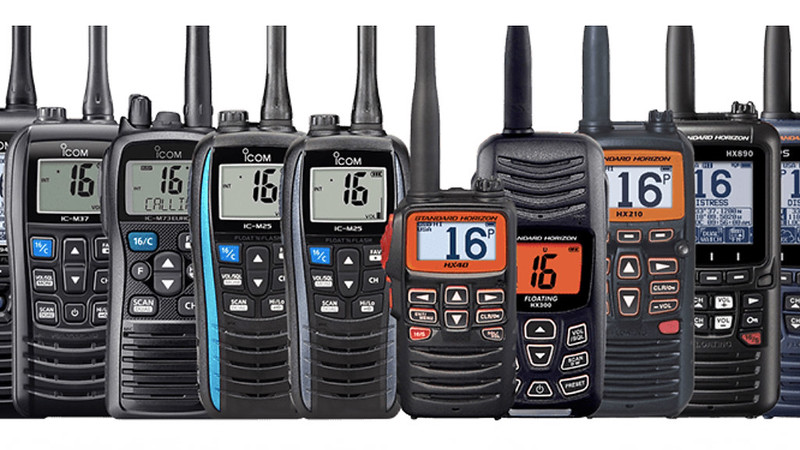
With developments such as AIS, Bluetooth and DSC, as well as battery technology and improvements in waterproofing, handheld VHF radio's now offer more than ever before. But all of these features come with costs including size, weight and battery life as well as your hard earned cash. As a sea kayaker, working out which is the best VHF radio for your specific requirements can be difficult but we have tried to simplify that with our Buyers Guide to Handheld VHF radios for Sea Kayakers.
Affiliate Disclosure: This page contains affiliate links. As an Amazon Associate and eBay Partner, we may earn a commission from qualifying purchases made through these links at no additional cost to you.
Cobra HH150
Budget.
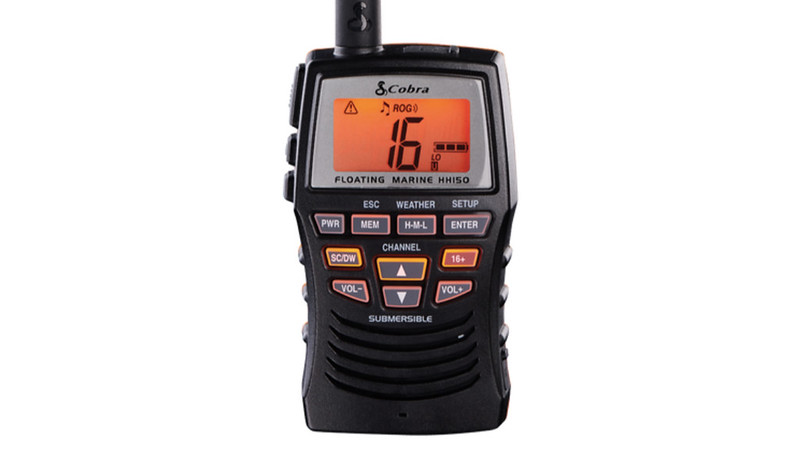
The Cobra HH150 is a budget, compact, waterproof and floating handheld VHF. With just 3W of transmission power its range can be less than other radios and its speaker output is quiet but these specs help it give longer usage times to its conveniently replaceable or rechargeable, but not very powerful, 5 NiMH AAA batteries.
Key Specs and Features:
- RRP: £79.99
- Waterproof: IPX7
- Float+Flash: Yes+No
- Transmit Power: 0.5/1/3W
- Audio output: 250 mW
- Battery: 5 x 850mAh AAA NiMH Rechargeable Batteries
- Charging: 12V cradle
- DSC + GPS: No
- Dimensions: 114x69x38mm
- Weight: 227g
- Warranty: 2 years
Standard Horizon HX210
Value.

The Standard Horizon HX210 is essentially a floating version of the ultra compact HX40 below. It has flotation built into it which adds to the units volume. This larger size also gives it more room for a few more buttons making operating it easier. When floating in the water it can flash a strobe to help it be found in the dark. This can also be programmed not to flash to save battery. It achives it's relative compactness by having a built in battery that can't be changed by the user.
Key Specs and Features:
- RRP £126.95
- Waterproof: IPX7
- Float+Flash: Yes (Flash can be turned off)
- Transmit Power: 1/2.5/6W
- Audio output: 600 mW
- Battery: 1850mAh Li-ion, built in.
- Charging: 12V or mains cradle
- DSC+GPS: No
- Dimensions: 132 x 60 x 40mm
- Weight: 280g
- Warranty: 3 years
Standard Horizon HX40
Ultra Compact.
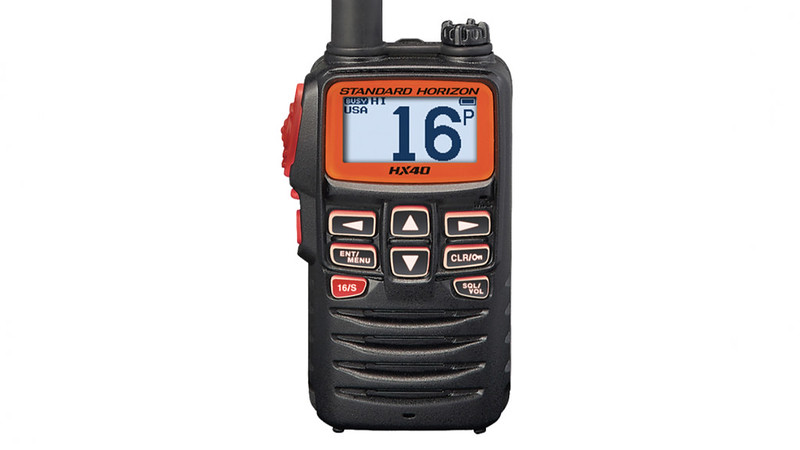
The Standard Horizon HX40 is a tiny but mighty VHF radio which for its size has a surprisingly powerful battery, packs 6W of transmission, has a useful battery save function and a reasonable cost. Perhaps its most appealing feature for sea kayakers is its ultra compact size which makes it so convenient to keep it in a PDF pocket, Excluding the arial it isn't much bigger than a pack of cards. It's compactness is partly due to having a built in battery that can't be changed by the user. The small size also comes at the cost of not floating, however the optional extra flotation case solves this if needed. For more indepth information see our Full Review: Standard Horizon HX40.
Key Specs and Features:
- RRP £131.95
- Waterproof: IPX7
- Float+Flash: No
- Transmit Power: 1/2.5/6W
- Audio output: 600 mW
- Battery: 1850mAh Li-ion, built in.
- Charging: 12V or mains cradle
- DSC+GPS: No
- Dimensions: 95 x 52 x 33mm
- Weight: 230g
- Warranty: 3 years
Standard Horizon HX320
Work Horse.

This good value, midsized VHF handheld radio has a powerful battery for its size making it a good choice for those sea kayakers that like to keep their radios on all day. Building the battery into the unit helps keep the overall size down. It's USB-C charging port adds the convenience of recharging from a battery pack which is great for expedition use. When immersed in water it floats and flashes a strobe, even when turned off.
Key Specs and Features:
- RRP: £159.95
- Waterproof: IPX7
- Float+Flash: Yes (Flash can be turned off)
- Transmit Power: 1/2.5/6W
- Audio output: 700 mW
- Battery: 2100mAh Li-ion, built in.
- Charging: USB-C
- DSC+GPS: No
- Dimensions: 133x60×42mm
- Weight: 290g
- Warranty: 3 years
Check price at: Amazon and Ebay
Icom M25 EVO
Slim.
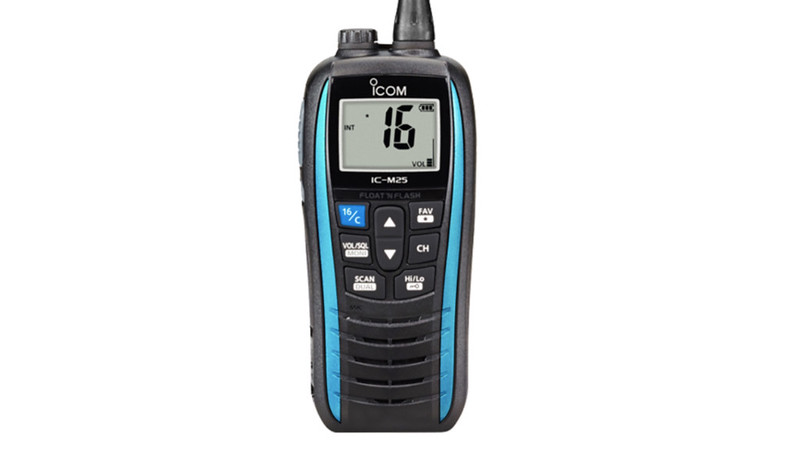
Updated to the EVO version in 2025, this lightweight and simplified VHF handheld radio is slim and tapered so that you can more easily put it in the narrow pockets often found in sea kayak or touring, centre zipped PFD's. It's smallish battery life can be extended when in eco mode howerver this reduces transmission power to 2.5 watts. It's updated USB-C charging port is useful for multi-day trips as it allows charging from portable power banks. It's 'flash and float' feature includes blue strips flashing.
Key Specs and Features:
- RRP: £179.99
- Waterproof: IPX7
- Float+Flash: Yes (Flash can be turned off by approved service centre)
- Transmit Power: 1/2.5/5W
- Audio output: 700 mW
- Battery: 1500mAh Li-ion, user changeable.
- Charging: USB-C
- DSC+GPS: No
- Dimensions: 134x57×3mm
- Weight: 225g
- Warranty: 3 years
Check price at: Amazon and Ebay
Icom M37
Big Battery.
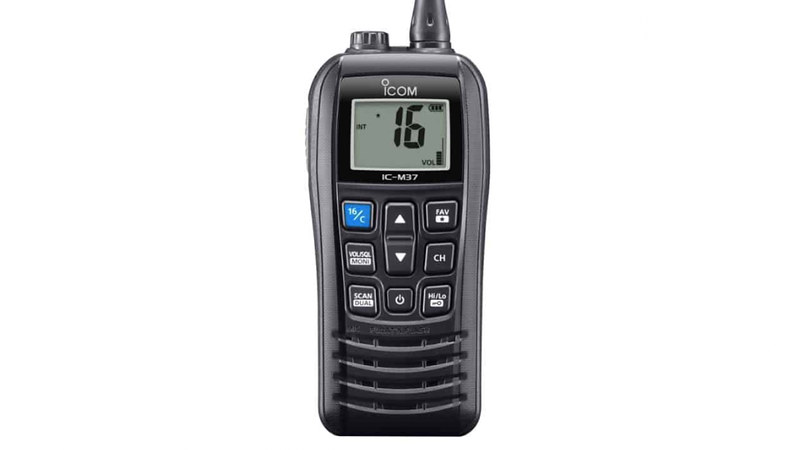
This handheld VHF unit is a real workhorse. It is designed for both the leisure and commercial market. It's standout feature's are its transmission power and its large battery capacity that gives better battery life than other handheld radios. However it is big, heavy and expensive for a unit that has no DSC/GPS.
Key Specs and Features:
- RRP: £218.74
- Waterproof: IPX8
- Float+Flash: Yes
- Transmit power: 1/6W
- Audio output: 700 mW
- Battery: 2350 mAh Li-ion, user changeable.
- Charging: 12V or mains cradle + AAA battery tray
- DSC+GPS: No
- Dimensions: 121x67x53mm
- Weight: 299g
- Warranty: 3 years
Check price at: Amazon and Ebay
Standard Horizon HX890
Expert Features.
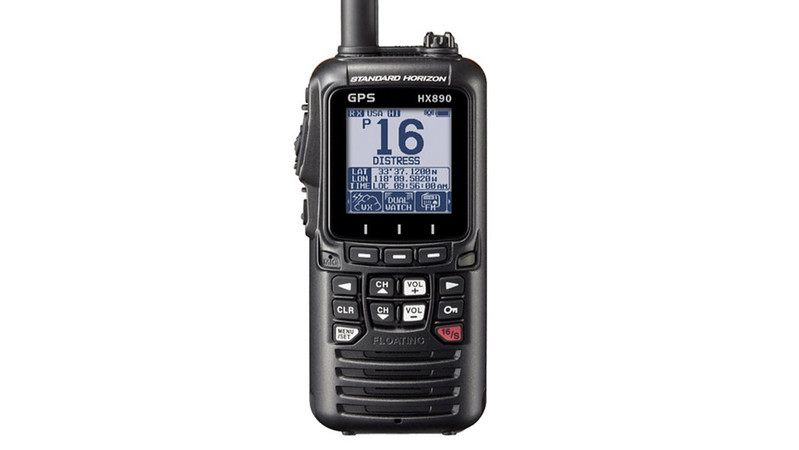
This top end VHF is packed with features such one button distress call, DSC calling, position sharing, waypoint navigation and navigation to DSC distress calls. It can also track and display position information of up to 9 other pre-selected DSC radios. It has noise cancellation function on both the transmitting and receiving audio. All these features come at a cost though, both financially and physically as this unit is expensive as well as big and heavy. It is the last of the Standard Horizon handhelds to not have the new built in battery and as such we expect it to be upgraded next.
Key Specs and Features:
- RRP: £246.95
- Waterproof: IPX8
- Float+Flash: Yes (Flash can be turned off)
- Transmit Power: 1/2/6W
- Audio output: 700 mW
- Battery: 1800mAh Li-ion, user changeable.
- Charging: Drop in cradle + AA battery tray
- DSC+GPS: Yes
- Dimensions: 138x66x38mm
- Weight: 310g
- Warranty: 3 years
Check price at: Amazon or Ebay
Cobra HH600
Bluetooth.
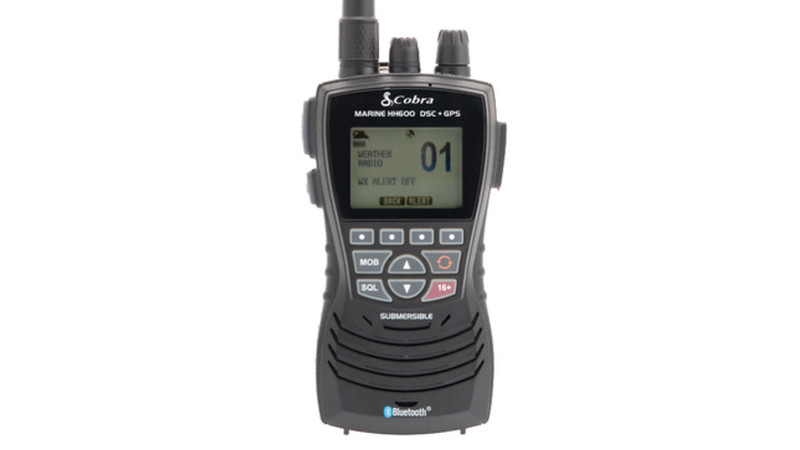
A unique feature of this VHF is bluetooth. This means you can have your phone packed away nice and dry in your boat and still be able to make and take calls. Another innovative feature, seen middle right on the unit keypad, is the 'rewind-say-again' button. This continually records and allows you to quickly re-listen to the previous 20 seconds. You might find yourself using this feature in windy conditions as this VHF has a quite speaker. This feature rich unit does drain its big and heavy battery quickly though and it's display isn't the clearest to read.
Key Specs and Features:
- RRP: £279.99
- Waterproof: IPX8
- Float+Flash: Yes+No
- Transmit Power: 1/3/6W
- Audio output: 250 mW
- Battery: 2000 mAh Li-ion, user changeable.
- Charging: Drop in cradle + AA battery tray
- DSC+GPS: Yes
- Dimensions: 131x72x47mm
- Weight: 329g
- Warranty: 2 years
Check price at: Amazon or Ebay
ICOM M94D
AIS Receiver.
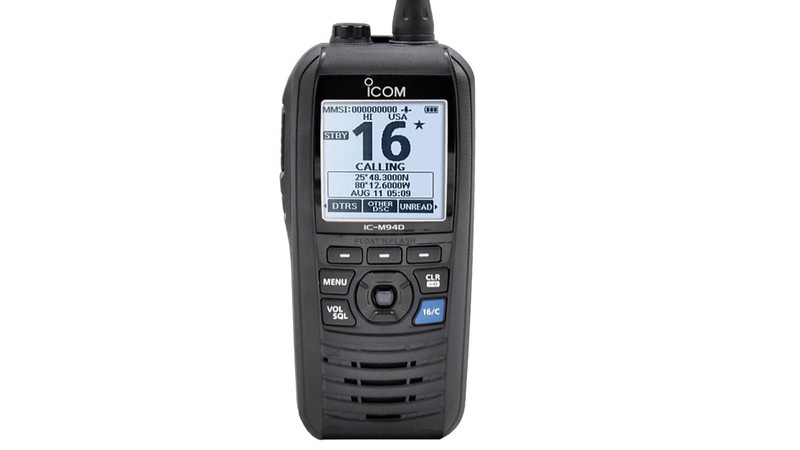
The Icom M94D is the flagship handheld VHF from Icom and as such is full of features. Most notably, it is the world’s first handheld VHF to integrate an AIS receiver. This uses AIS and GPS to plot the positions, speeds, and headings of nearby AIS broadcasting vessels directly on its screen. This is an invaluable tool for navigating shipping lanes, especially in low visibility conditions like fog or darkness. While the M94D lets you "see" other vessels, it does not broadcast your AIS data, so it doesn't help you be "seen". This unit has an exceptionally loud speaker and also features two way active noise canceling. These features come at a financial cost though and also require a big and heavy battery. And while it is waterproof it isn't rated for continuous immersion, unlike other high end, hand held, VHF radios.
Key Specs and Features:
- RRP: £362.80
- Waterproof: IPX7
- Float+Flash: Yes
- Transmit Power: 6W
- Audio output: 1500 mW
- Battery: 2400 mAh Li-ion, user changeable.
- Charging: 12V or mains cradle + AA battery tray
- DSC+GPS: Yes
- Dimensions: 146×61x44mm
- Weight: 357g
- Warranty: 3 years
Check price at: Amazon and Ebay
Need to Know
Waterproof - The use of keypads make waterproofing radios easier, eliminating the problem of worn O-rings on rotary knobs. Drop in cradle charging also eliminates the potential leak point of an charging port. IPX7 is protected against water immersion for 30 minutes at a depth of 1 meter. IPX8 is protected against continual water submersion at a depth of over 1 meter.
Float + Flash - Floating is undoubtably a handy feature but it requires the VHF to be bigger than would otherwise be necessary. The Flashing feature refers to a 'water activated strobe' that will flash a light if the unit gets wet. While this is a useful feature if you drop your VHF in the water at night, it can slowly drain the battery if the sensor gets wet when practicing rescues etc.
Transmit Power - This is the amount of electrical power used for the transmission of the call. As VHF range is based on line-of-sight, not wattage, 'kayaker to kayaker' range is only 2-3 miles, regardless of whether they are using 1W, 5W, or 6W. However higher wattage helps "punch through" interference or reach a tall Coast Guard antenna (which can see you from 20 miles away because of its height).
Audio Output - This translates as the maximum volume of the speaker and is important for hearing the transmitted message in noisy environment's such as strong wind and waves. Noise cancellation on the received transmission also helps here. Noise cancellation on the transmitter signal helps the receiver hear more clearly.
Battery - Whilst there are industry standards for measuring battery life with handheld VHF's they don't take into account the more recent features such as GPS, Bluetooth and AIS, which all have high demands on the battery when being used. Sea kayakers however will often turn off these features when not needed to save power. The best measure therefore is the battery capacity. The composition of batteries affects how they behave too. Nickel Cadnium (Ni-Cad) batteries have a 'memory effect' where they have to be fully discharged before being recharged or they will not hold as much. Lithium Ion batteries (Li-ion) don't have as strong a memory effect but they self-discharge at about 1-3% per month. These batteries can either be user changeable for convenience or built in making the devices more compact.
Charging - While historically USB ports were a potential water ingress point, modern radios with USB-C ports use internally sealed ports. Even if the rubber bung is left open, water cannot enter the internal circuitry of the radio. Likewise the contact points used for cradle charging used to corrode quite quickly in older models but this has now been sorted. Cradle charging is convenient, but is a bulkier setup to carry in your kayak on an expedition.
DSC+GPS - DSC (Digital Selective Calling) can be paired with GPS (Global Positioning System) to allow the user, with the press of a button, to transmit an alert on the VHF radio waves. This will include the vessel information and position and is transmitted to all other DSC-equipped units and rescue facilities within range. Both DSC and GPS will take power from the battery when turned on.
AIS - (Automatic Identification System) is a digital tracking system that uses the VHF radio waves to automatically broadcast and/or receive a vessel’s identity, GPS position, speed, and heading, allowing you to "see" and be "seen" by other AIS-equipped ships even in fog or darkness. This will take power from the battery.
Operating Area - VHF's are built for two main operational areas, International (which includes Europe) and the USA and Canada. International (and European) compatable model numbers often end with the addition of Euro or E. Radios set for the incorrect area will work, they just wont have access to all the channels.
'Calling for Help' - Most sea kayakers like to carry more than one means of calling for help. Our Buyers Guide to PLB's for Sea Kayakers and Buyers Guide to Satellite Phones for Sea Kayaks cover some more of these devices.

By Philip Clegg
With over two decades of working in the sea kayaking industry, Phil is a Paddle UK Level 5 Sea Kayak Coach and former record holder for the Circumnavigation of Britain. He can mainly be found coaching on the sea around Anglesey. That's when he's not researching and writing on all things sea kayaking.
